Generic B-Roll Doesn't Work Anymore. Here's What to Put on Screen Instead
Skyscrapers from below, hands typing on a laptop, a handshake. Viewers have seen these clips a thousand times and they read as filler. Here is a simple test for B-roll that actually holds attention, when to show the real thing, and when generating the shot is the better call.
A post did the rounds in r/PartneredYoutube and r/SmallYoutubers last month from an editor who has spent two years cutting talking-head videos for business, finance and education channels. The line that stuck:
"I used to just slap Pexels footage of random skyscrapers or a guy typing on a keyboard over boring business talk. It doesn't work anymore."
Anyone who watches YouTube knows the shots. The glass tower from below. Hands on a laptop. Two people shaking hands in suits. A spinning globe. A timelapse of traffic. They show up in so many videos that viewers stop registering them as pictures at all. They register as filler, and filler is the moment people start scrolling.
Why generic B-roll stopped working
It carries no information. Here's the test: could this shot sit under any other sentence in the video? A guy typing on a keyboard works under "we launched in March," "our churn doubled" and "I quit my job." If a shot fits everywhere, it says nothing anywhere.
Viewers have seen it before. Literally. Stock libraries are big, but the clips that come up first for "business" or "success" are the same ones every channel picks.
It's part of the same reflex as over-editing. The editor's post was mostly about the hyper-edited style dying out: zooms every half second, nonstop motion graphics. "Viewers are just exhausted by it." Generic B-roll comes from the same place. Something has to be on screen, so anything goes on screen.
It does nothing to make the video yours. That matters more than it used to, now that YouTube is cutting Shorts reach for videos that don't add anything of the creator's own. A licensed stock clip isn't a re-upload, but it isn't your take either.
The test: what was just said?
Good B-roll is specific to the sentence it sits under. You couldn't pick it without hearing the line right before it.
- "Our churn doubled in March." Generic: hands typing on a laptop. Fits: your actual dashboard, everything dimmed except the churn number.
- "One cold email changed everything." Generic: a stock inbox animation. Fits: a screenshot of the real email.
- "We moved everything to cloud infrastructure." Generic: clouds in the sky. Fits: rows of server racks in a data center.
- "We maxed out the cards." Generic: a stack of cash. Fits: worn credit cards on a desk, in the era the story happened.
- "It started in my dad's garage." Generic: a tidy modern garage. Fits: a cluttered workbench, the way that garage actually looked.
The cloud one isn't made up for effect. Someone on Reddit asked last month whether any AI B-roll tool can "follow the idea of the sentence," after one "heard cloud infrastructure and gave me literal clouds." Keyword matching is how generic B-roll happens, whether a person or a tool is doing the searching.
Show the real thing when it exists
The editor's fix for business videos had nothing to do with AI. When the creator talks about software, an email or a revenue number, they put the actual screenshot on screen, then "darken the whole screen except the exact metric I want the viewer to look at. It forces their eyes right to the proof."
That's the right call, and no tool will beat it. If the thing you're talking about exists and you can show it, show it:
- The dashboard, the email, the invoice, the spreadsheet.
- A screen recording of the product doing the thing.
- Photos from the time the story happened.
- The actual place, if you can get there with a phone.
Generate what you can't screenshot
A lot of what people say on camera has no screenshot. The garage in 1985. The night the deal fell apart. The first apartment. The trip that changed their mind. A scenario they're asking you to picture.
Those are exactly the moments that end up covered with a handshake or a skyscraper, because there's nothing real to show and no time to film it. That's where generated B-roll belongs, as long as it's built from what the sentence means rather than one word in it.
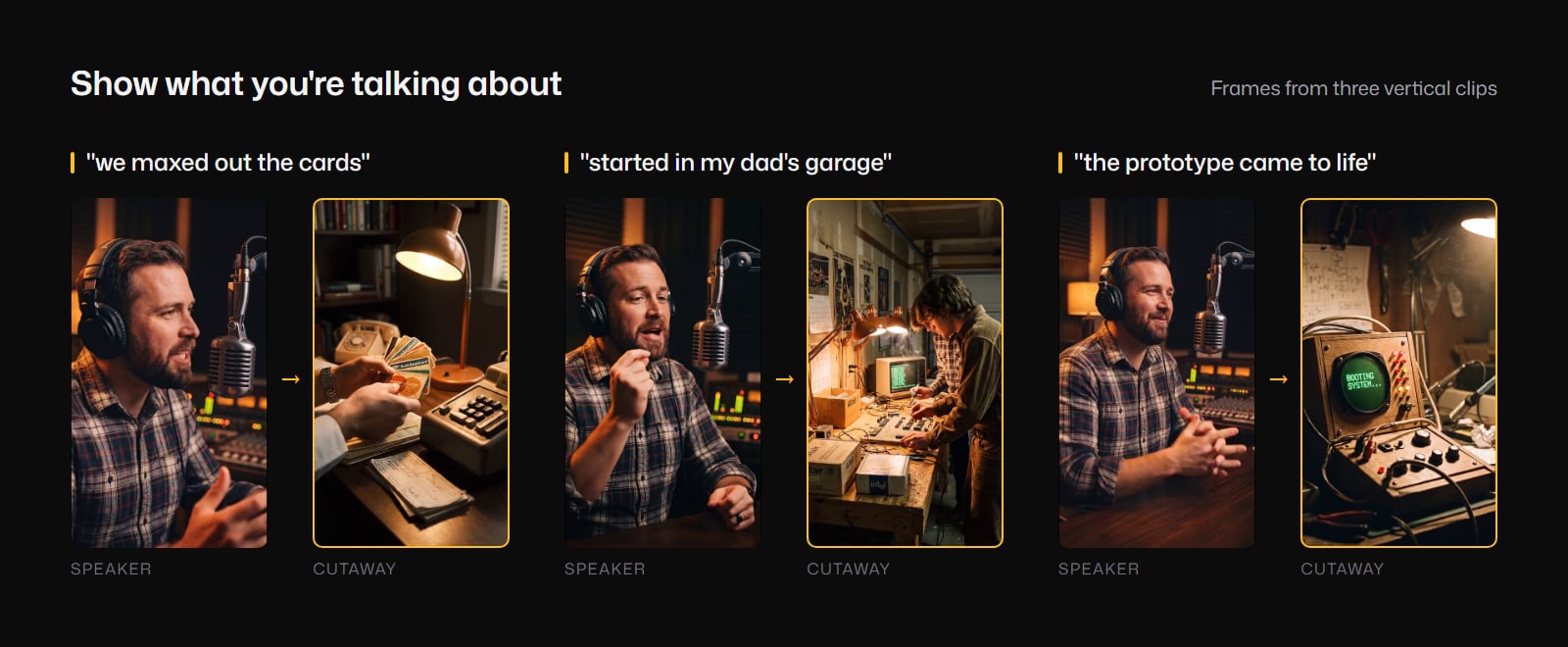
Look at the three cutaways above without the quotes and they're just nice shots. Put the quotes back and each one is the only shot that fits. That's the difference between generated B-roll that works and AI slop: one follows the story, the other decorates it.
How to tell if an AI B-roll tool is past keyword matching
Before you trust any tool with a whole video, ours included, give it a short clip with a few lines that would trip a keyword matcher. Things like "we were drowning in support tickets," "the market went cold," or "cloud infrastructure." Then look at what it picked:
- Did it read the idea or the word? Drowning should never mean water.
- Does the same person look the same across clips? If a story about one founder stars five different people, it reads as fake, fast. A reference image fixes this, which we covered in the character consistency guide.
- Did it cover everything? A tool that puts a visual on every sentence is a stock library with extra steps. Plenty of lines are better on your face.
- Can you fix its choices before it generates? It will miss sometimes. What matters is whether you can rewrite the miss before you pay for it.
Where Compledio fits
The slow part of B-roll was never the clip. It's deciding where visuals go and what each one should be, for every line in the video. The most upvoted post in r/NewTubers last month was a creator saying "It takes me about 1-2 hours to edit 1 minute of video and my edits arent even fancy," and hunting for B-roll is a big piece of that.
Compledio takes that part. It transcribes your video or audio, reads the whole thing, picks the moments where a visual would help, and writes each shot from what's being said, not from a keyword. You set how much of the runtime gets covered, so there's room left for your face and your real screenshots. Then you review the list before anything generates: rewrite the misses, and cut the moments where you'd rather drop in the real dashboard yourself.
The short version
- Generic B-roll fails because it could sit under any sentence, so it says nothing.
- The test for any shot: could you pick it without hearing the line before it?
- When the real thing exists, a screenshot, an email, a number, show that.
- Generate the moments you can't screenshot: stories, places, the past, a scenario.
- Judge AI B-roll tools on whether they follow the idea of the sentence, keep people consistent, and let you fix their picks first.
If you want to see what your own video looks like when every cutaway follows the line before it, try Compledio on one video and check the shot list before you generate anything.